
Automatic AI Agent Skills: How Gobii Learns Workflows
Learn how Gobii saves repeatable AI agent workflows automatically, without installing SKILL.md files, and what a 49-skill benchmark says about performance.
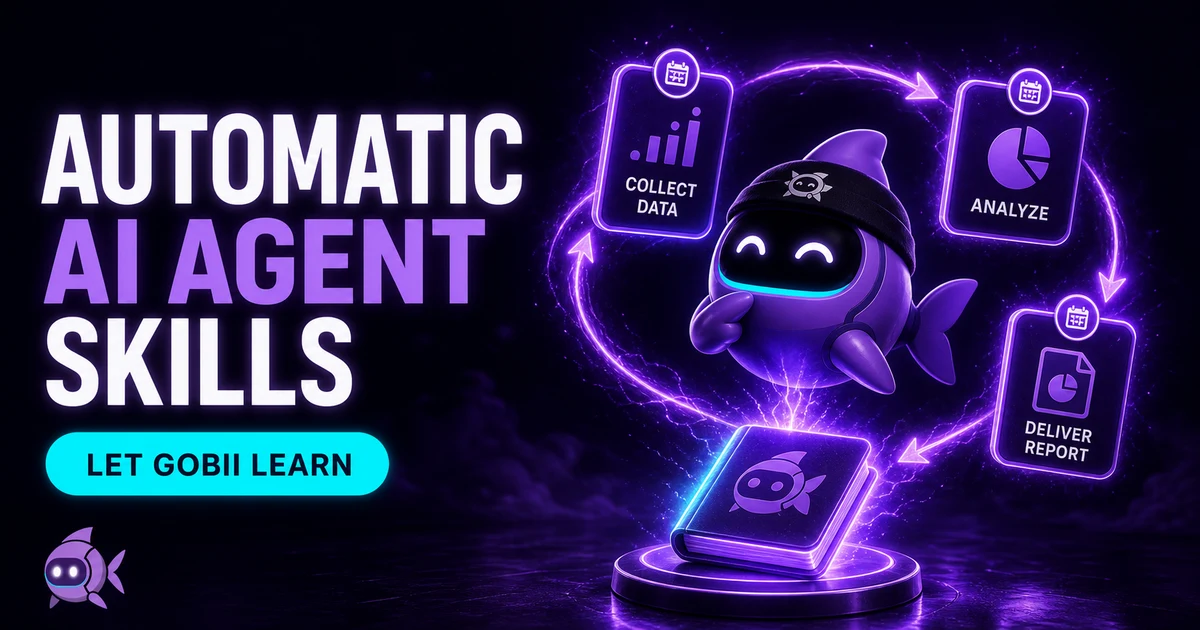
AI agent skills are operating procedures an agent can reuse for a defined job. File-based systems usually begin with someone creating or installing the skill. Gobii can take another route: learn the procedure while doing real work, save it quietly, and recall it when the same kind of assignment returns. That automatic step changes the setup. You do not have to write a SKILL.md file or maintain a directory. Nothing needs to be installed for the learned workflow. Give a Gobii a concrete job, correct the process in plain language, and let the work supply the playbook.
In July 2026, we queried the DataForSEO Labs Keyword Overview endpoint for two U.S. English terms. It reported 590 monthly searches for "AI agent skills," a 4,300% yearly trend, and 6,600 for "agent skills." Current results lean heavily toward building or installing files. This guide covers the less familiar case: an agent learning the procedure for you.
Key takeaways
- Learned Gobii workflows need no separate skill install.
- A useful skill records the repeatable method, the approved tools, and the checks that define an acceptable result.
- Reuse cuts setup time. It does not replace fresh data, scoped access, exception handling, evaluation, or human judgment where consequences are hard to reverse.
Let Gobii learn a recurring workflow
In this guide
- What AI agent skills are
- How automatic learning works
- Gobii versus file-based skills
- What should become a skill
- Skills versus other context
- Review and improvement
- Practical examples
- Frequently asked questions
Keyword research method
We ran DataForSEO Labs Google Keyword Overview on July 19, 2026 with location_name: United States, language_code: en, and clickstream normalization disabled. DataForSEO last updated the "AI agent skills" record on July 14 and the broader term on July 11. Volumes are rounded database estimates, not forecasts or guaranteed traffic.
What Are AI Agent Skills?
An AI agent skill is a reusable procedure for one recognizable kind of work. Under the open Agent Skills specification, names can contain up to 64 characters and descriptions up to 1,024. Those two fields help the agent decide when the instructions belong in a task (Agent Skills specification, retrieved July 19, 2026). "Remember this" is too loose. A procedure captures the sequence, relevant tools, output requirements, checks, and exceptions. Consider a weekly revenue report. Its playbook might name the system of record, calculation rules, segment breakdown, materiality threshold, and email format. This week's revenue figure stays out because next week's figure will differ.
Use the following questions before keeping that compact playbook:
| Design question | What the answer should establish |
|---|---|
| When does it apply? | A trigger and scope specific enough to avoid false matches. |
| What repeats? | Stable business steps rather than incidental clicks in one interface. |
| What may it use? | Approved systems, access boundaries, and any credential requirement. |
| What counts as done? | Required fields, format, destination, and quality checks. |
| When must it stop? | Exceptions, approval points, retry limits, and a route back to the user. |
That boundary prevents category creep. A price, account balance, or news item is data to retrieve. By contrast, "check the CRM, compare the last 30 days, flag changes above the agreed threshold, then draft a review table" describes a procedure.
How Does Gobii Learn Skills Automatically?
The open file-based standard has three loading stages: discovery, activation, and resource access. Gobii's learned-skill path starts earlier. Once a stable procedure becomes clear during work, the agent can save it to skill memory and recall it for a later match (Agent Skills overview, retrieved July 19, 2026).
The sequence looks like this:
- Start with real work. Ask for a report, a monitoring job, or another concrete outcome.
- Make the method visible through use. Corrections reveal preferred sources, calculation rules, acceptable formats, and where review belongs.
- Let Gobii preserve what repeats. It can save the stable instructions and tool requirements silently, without interrupting the conversation to ask you for a package or configuration file.
- Return with a matching assignment. The saved procedure comes back into working context.
- Revise from evidence. If a later run exposes a bad assumption, correct the narrow instruction. Gobii records an updated version so the next attempt uses the better playbook.
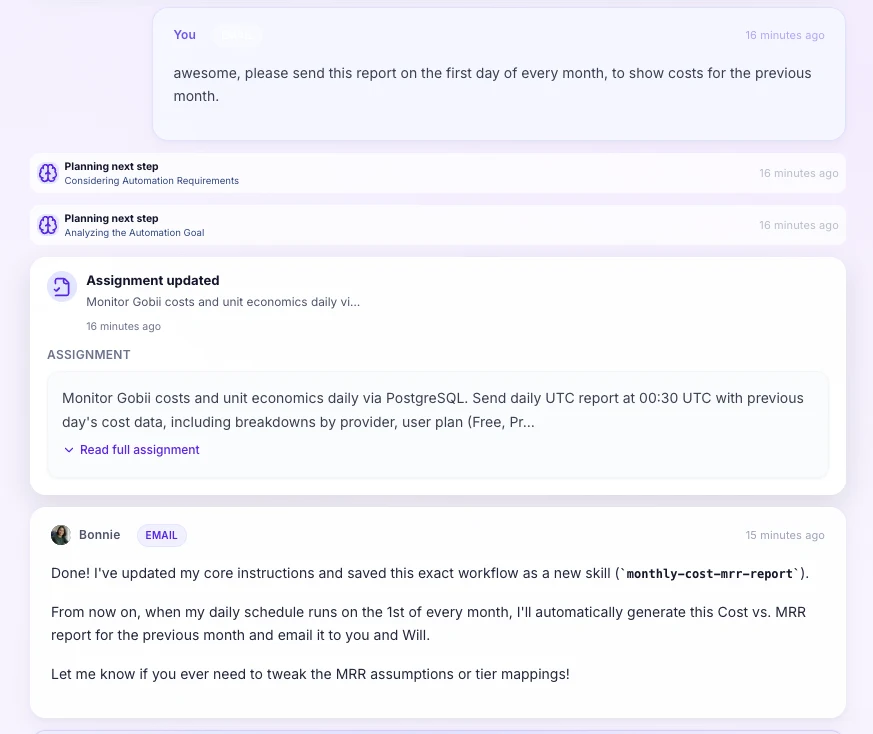
Above is a monthly cost report. After the user updates the recurring assignment, Gobii saves the source logic, calculations, timing, and delivery rules as monthly-cost-mrr-report. Next month's schedule can reuse that method. In our experience testing this implementation, silent maintenance matters as much as reuse. People improve work in ordinary language. Requiring them to translate each correction into another configuration artifact would put the burden in the wrong place.
Automatic does not mean indiscriminate. One-off requests, uncertain preferences, and sensitive values belong elsewhere because they lack a durable procedural role. Nor does a learned skill bypass authentication or an approval rule. Missing connection? The agent must request access rather than improvise around a credential boundary. A consequential external action still waits wherever your procedure says it should.
Gobii vs. Claude and Codex Skill Files
The open Agent Skills format requires at least one SKILL.md file inside a skill directory. Packages may also carry scripts, references, templates, or other assets. Claude and Codex support this portable model. After someone creates and makes the package available, the client can select it automatically for a matching task (Agent Skills quickstart, retrieved July 19, 2026; OpenAI Skills, retrieved July 19, 2026). Gobii addresses a different moment in the lifecycle. A persistent agent can derive its procedure from work already completed with you. For that learned workflow, there is no separate file to author or upload. There is no install prompt either.
| Question | Gobii learned skill | Claude or Codex file-based skill |
|---|---|---|
| Who creates the first version? | The Gobii can save it from a clear workflow encountered during work. | A person, team, or skill creator produces a skill package. |
| What must the user install? | Nothing separate for the automatically learned workflow. | The skill must be made available or installed in the supported client. |
| How is it selected later? | The agent matches the current job to its saved procedure. | The client discovers skill metadata, then loads matching instructions. |
| Where is it most useful? | Agent-specific work that improves through use and feedback. | Portable or team-approved capabilities shared across products and projects. |
| Can it include tools and requirements? | Yes. Gobii saves tool references, instructions, and secret requirements. | Yes. A package can include instructions, scripts, references, assets, and allowed tools. |
| Does it guarantee a correct result? | No. Data, permissions, models, and external systems can still change. | No. The skill still has to match the task and current environment. |
A reviewed, portable skill makes sense when one approved process must travel across clients or projects. Automatic learning fits an agent-specific job that changes through use and feedback. Many teams will need both. The distinction is who bears the setup work.
What Should Become a Learned Agent Skill?
In 2026, SkillLearnBench tested 20 skill-dependent tasks across 15 subdomains. Its researchers found that continual learning helped most when the work followed a clear, reusable process; open-ended assignments were less dependable (SkillLearnBench, retrieved July 19, 2026).
Use this checklist before treating a workflow as a durable skill:
- Recognizable trigger. "Prepare the Friday pipeline report" is clearer than "help with sales."
- Stable method. Inputs can change while the underlying business steps remain identifiable.
- Testable result. Name the columns, citations, sections, or recipient. For numerical work, include at least one reconciliation or range check before delivery.
- Known tool boundary. State what the agent may read. Be equally explicit about writes, messages, and any action that changes another system.
- Safe exception path. A missing page may justify a retry; conflicting totals should pause the run. Define those outcomes before they happen.
- Feedback from an actual run. First attempts hide assumptions. A correction about source quality, field mapping, or approval timing often supplies the detail that makes the procedure worth keeping.
Repetition alone is weak evidence. Two runs that look similar at first can depend on different policies, data contracts, or approval requirements once you inspect them. Ask the agent to name the candidate procedure. Before trusting the next match, check every step it treats as invariant against the actual business rule.
The best learned skills compress decisions rather than clicks. "Open this page, then that menu" breaks when an interface moves. "Use the approved billing source, compare the closed period with the prior one, explain material variance, and wait before sending" preserves the business logic through that change.
Skills vs. Memory, Custom Instructions, and Templates
Gobii's persistent timeline records seven event types, including messages, plans, deliverables, tool activity, files, requests, and processing state. A learned skill is only one structured slice of that continuity. It preserves the procedure for a job, not the agent's complete history (Gobii Chat and Timeline, retrieved July 19, 2026). Separation keeps the procedure small enough to inspect. The open specification recommends a main SKILL.md under 500 lines and 5,000 tokens. Core instructions stay close; deeper reference material can load only when needed (Agent Skills best practices, retrieved July 19, 2026).
| Context surface | Put this there | Example |
|---|---|---|
| Agent Skill | Repeatable steps, tools, output rules, and checks | "Build the weekly pipeline report using these sources and sections." |
| Persistent memory or timeline | Past events, decisions, requests, and deliverables | "Last Tuesday, finance approved the revised forecast." |
| Custom Instructions | Standing behavior, tone, boundaries, and organization rules | "Use ISO dates and never send external email without approval." |
| Team Template | An approved starting configuration for new agents | "Launch a research agent with our standard role and connections." |
| Fresh retrieval | Facts that can change | Current price, inventory, account state, policy, or news. |
| Secret storage | Credentials and scoped access | API key, login token, or service credential. |
Persistent AI agent memory carries context across conversations. Put rules that shape many unrelated tasks in Custom Instructions, where they can govern tone, boundaries, and organization-wide behavior together. Groups needing an approved starting configuration can choose Team Templates. The learned skill occupies a narrower middle: one durable job, ready to repeat.
How Do You Review and Improve a Learned Skill?
In 2026, SWE-Skills-Bench paired 49 public skills with about 565 real software tasks. Thirty-nine produced no pass-rate improvement. Seven delivered meaningful gains of up to 30%, while three reduced performance by as much as 10% (SWE-Skills-Bench, retrieved July 19, 2026).
The benchmark covers coding skills, not a Gobii product evaluation, but the operational lesson transfers: saving is not proof. Test the learned procedure from four angles.
| Test | Evidence to inspect |
|---|---|
| Activation | It appears for the intended assignment and stays out of unrelated work. |
| Procedure | Stable steps remain intact without stale facts leaking into the run. |
| Outcome | The deliverable passes the real business checks, not merely a format check. |
| Cost and friction | Reuse cuts repeated prompting, redundant tool calls, avoidable retries, or review time. |
Run the next instance with a known-good input and compare it with the former manual process. If it fails, fix the narrowest instruction. Test again. Version history matters here because earlier runs may have followed guidance that has since changed.
Coverage can expose a false sense of success. In 2026, researchers found that benchmark trajectories exercised only 38.66% to 45.51% of the constraints inside tested skills. Strengthening instructions tied to observed failures recovered 16% of failed tasks on average (Skill Coverage, retrieved July 19, 2026). An easy pass may leave the exception that matters most untouched.
Automatic AI Agent Skill Examples
In 2026, SkillLearnBench drew tasks from 15 subdomains. Reusable procedures are not limited to coding. Strong candidates combine stable business logic with changing inputs and an outcome somebody can check (SkillLearnBench, retrieved July 19, 2026).
Weekly metrics report
The skill identifies the approved source and reporting period. Numbers are fetched anew. Calculation rules, materiality thresholds, and the summary format persist, which is useful when the source or deliverable uses Google Sheets automation. Before delivery, reconcile at least one total against the source.
Logged-in website monitoring
For a private portal, the saved procedure can name pages to inspect, comparison logic, evidence to capture, and alert conditions. Scoped secret storage handles the credential separately. Read the access boundaries in our guide to website automation behind a login before monitoring a production account. A changed login screen should pause the run, not invite a workaround.
Research and sourcing
Research and sourcing depend on judgment. Preserve the qualification rules, evidence standard, exclusions, and review-queue format. Keep the final decision with a person. Gobii's Recruitment Sourcing skill follows that pattern, and feedback about an irrelevant source can improve the next search.
Connected app triage
Triage begins with an agreed rubric. From there, the agent can read new items, classify them, and draft a response. Sensitive writes still wait. One-click integrations supply the connection, but the procedure itself grants no access.
Recurring research brief
A recurring brief can preserve its date window, source standard, comparison dimensions, citation style, and delivery schedule while gathering new evidence each time. Add visible AI agent planning when research has dependencies or needs a checkpoint before synthesis. Simple briefs may not need a plan at all.
Frequently Asked Questions
The open Agent Skills standard loads content in three stages. Gobii's learned workflow adds an earlier moment: the agent can create the reusable procedure from its own work instead of waiting for a user to install a package (Agent Skills overview, retrieved July 19, 2026).
Do I have to create or install a skill in Gobii?
Not for an automatically learned Gobii workflow. Assign the recurring job and correct its method in normal language. Once the procedure is stable enough to reuse across another run without carrying over stale facts, the agent can save it quietly. Portable or built-in capabilities follow a different setup path.
Does automatic mean Gobii saves everything as a skill?
No. A durable procedure belongs in a skill; current facts and credentials do not. Say when a process is temporary. If the job later changes, correct the saved method or remove it.
How is a Gobii Agent Skill different from persistent memory?
Persistent memory carries decisions, messages, files, and work history. An Agent Skill holds a structured procedure. The first answers "what happened?" The second answers "how should this job run again?" Triggers, tools, requirements, and output checks belong with that procedure.
Can a learned skill use integrations and logged-in websites?
Yes, when the required connection and permission already exist. A skill can record which tool to call, what operation the procedure expects, and which secret the job requires. It neither contains nor bypasses that credential. Missing access should produce a request.
Will a skill make every future result identical?
No. Source data changes. Websites move, tools fail, and user requirements shift. Define checks for those conditions, preserve approval points around consequential actions, and evaluate each meaningful revision against representative tasks.
Let Repetition Teach the Agent
In our July 2026 DataForSEO snapshot, the yearly trend for "AI agent skills" was 4,300%. The practical opportunity is not collecting files. It is turning repeated explanation into a tested procedure while data, permissions, and judgment stay current. Choose one bounded workflow you already repeat. Tell your Gobii the outcome and approved tools. Add the output format, review point, and stop conditions only where the work needs them. Correct what goes wrong on the first run. Next time, inspect whether the saved skill activated for the right reason and removed setup without concealing a mistake.
Feedback compounds. Automatic Agent Skills make it useful later by teaching the agent how to approach the same kind of work again.