
Your agent remembers your feedback
Gobii agents can now carry corrections to tone, format, and approach into future work, while message ratings and progress updates make chat feedback clearer.
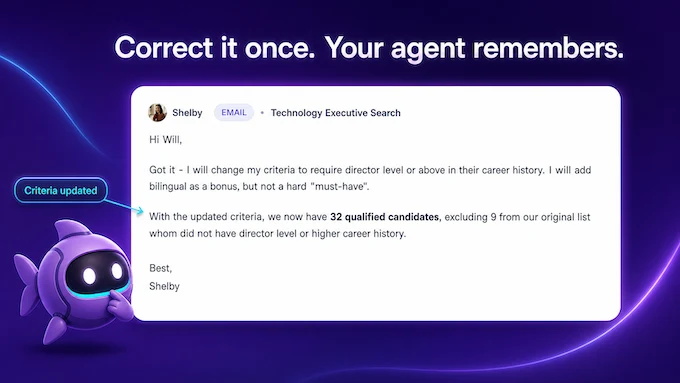
Good feedback should improve the next result, not disappear when the current task ends.
Gobii agents can now carry corrections to their tone, format, or approach into future work. You can refine how an agent handles a task without rebuilding it or replacing everything else you have taught it. This adds a more targeted feedback loop to Gobii's existing persistent agent memory.
We have also added thumbs-up and thumbs-down controls for individual messages. For substantial assignments, agents can now send a kickoff and a useful milestone before delivering the finished result.
Key Takeaways
- Corrections to tone, format, and approach can carry into future work.
- A new correction does not replace the rest of an agent's instructions.
- Message ratings, kickoff notes, and milestone updates make feedback and progress clearer in chat.
How Does Agent Feedback Memory Work?
Agent feedback memory starts with a correction you make while the work is happening. Tell an agent to change a repeatable part of its output, and it can apply that guidance now and in future work while preserving the rest of its context.
For example:
"Keep client updates under five bullets. Lead with blockers. Skip the warm-up."
The current update follows that direction. Future updates can, too. You do not need to rebuild the agent or dig through its settings just to preserve a useful correction.
The same pattern applies beyond writing style. A recruiting agent might learn that a candidate needs director-level experience. A reporting agent might learn to lead with exceptions. A research agent might learn which evidence belongs in its final summary. The important part is that the correction is specific enough to reuse.
Does New Feedback Replace Existing Instructions?
No. Feedback memory is designed to update the relevant part of an agent's approach without wiping the rest of its instructions. A formatting correction should not erase its research process. A tone adjustment should not remove the rules that keep a workflow on track.
That distinction matters because useful agents collect context over time. Each correction should make the agent more aligned, not force you to choose between the new preference and everything that already works.
Custom Instructions remain the right place for standing personal or organization-wide rules. Feedback in chat handles a different moment: you see the work, make a correction, and let the agent carry that refinement forward.
How Do Thumbs-Up and Thumbs-Down Ratings Help?
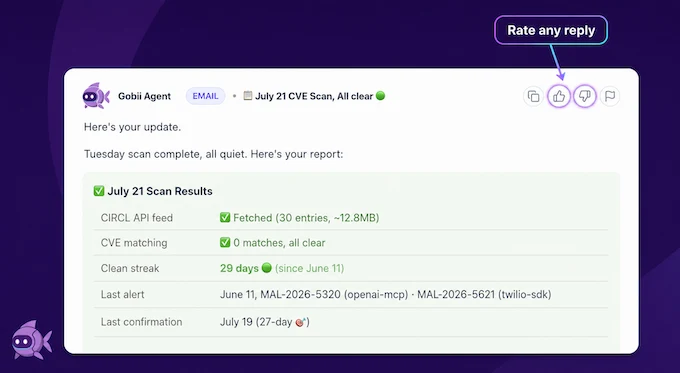
You can now rate an individual agent message with a thumbs-up or thumbs-down. The controls sit beside the reply, so you can send a quick signal without interrupting the conversation or writing a separate explanation every time.
Ratings complement written corrections. A rating tells us whether a reply was useful; a direct instruction tells the agent what to change. Together, they create a clearer path for improving agent responses while keeping the feedback close to the work that prompted it.
What Will Agents Share During Longer Assignments?
When an assignment requires substantial work, an agent can now send a kickoff update and a useful milestone before the final result. The kickoff confirms that the work is underway. The milestone gives you meaningful progress to review without turning every internal step into noise.
This is the same principle behind letting agents show their work: visibility should help you understand progress and make decisions. It should not make you supervise every action.
Clear updates are especially useful when a task includes several stages, such as collecting sources, comparing evidence, and preparing a report. You get enough context to know where the work stands, then the agent returns with the finished result.
Why Does This Make Agent Work More Reliable?
Reliability is not only about finishing a task. It also means following your instructions consistently, preserving the context that matters, and keeping you informed along the way.
Feedback memory helps an agent stay aligned after you refine its approach. Message ratings give you a fast way to respond to individual outputs. Kickoff and milestone updates make longer assignments easier to trust while they are still in progress.
These changes continue the less visible reliability improvements behind smoother agent runs. The result is less repetition, more control, and an agent that works more like your agent each time you refine it.
Frequently Asked Questions
What kinds of feedback can a Gobii agent remember?
Gobii agents can carry corrections to tone, format, or approach into future work. Useful feedback is specific and reusable, such as asking for shorter client updates, a different report structure, or stricter sourcing criteria. The correction can apply without replacing the agent's other instructions.
Do I need to rebuild an agent after giving feedback?
No. Give the correction where the work is happening. The agent can apply it to the current result and carry it into future work, so you do not need to rebuild the agent or repeat the same adjustment in its settings.
Does thumbs-down automatically tell the agent what to change?
A thumbs-down sends a quick signal that the reply was not useful, but a written correction gives the agent the clearest direction. Use the rating for fast feedback, then add a specific instruction when you want the agent to change its tone, format, or approach.
Will every long task include progress updates?
Kickoff and milestone updates are intended for assignments that require substantial work. The goal is to share useful progress before the final result, not add noise to every short task. Agents can share these updates when they help clarify what is underway and what has been completed.