
Persistent AI Agent Memory: How Gobii Keeps Context
Persistent AI agent memory uses 3 Gobii context layers so instructions, timelines, and reusable work carry across long-running tasks without starting over.
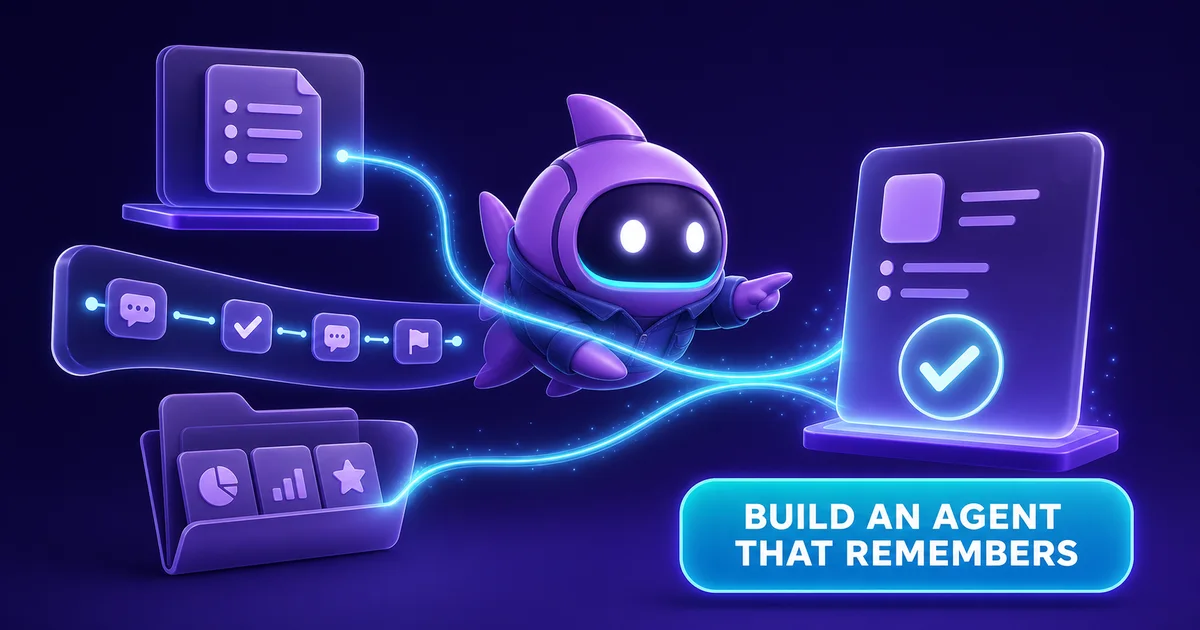
Long jobs expose the difference between a prompt and memory. Persistent AI agent memory lets an agent use relevant context after a chat ends, which matters when work lasts for days, draws on many files, or runs on a recurring schedule. Instead of treating each message as a fresh start, a persistent Gobii carries its role and work record forward.
Memory is not magic. For its 2025 Context Rot report, Chroma tested 18 language models and found that results became less reliable as the input grew (Chroma, Context Rot, July 2025; retrieved July 19, 2026). That result points to a design rule: reliable memory preserves state and retrieves the right facts. It does not load every past word into an infinite prompt.
Key takeaways
- Persistent memory pairs durable state with retrieval.
- Gobii keeps standing instructions, timeline history, and reusable files in separate homes so the current task gets useful context instead of one infinite prompt.
- Memory saves mistakes too; correct stale guidance and protect credentials.
In this guide
- Definition.
- Context windows.
- Gobii memory model.
- What to remember.
- Teaching an agent.
- Safety and privacy.
- Developer access.
- Testing.
- FAQ.
What Is Persistent AI Agent Memory?
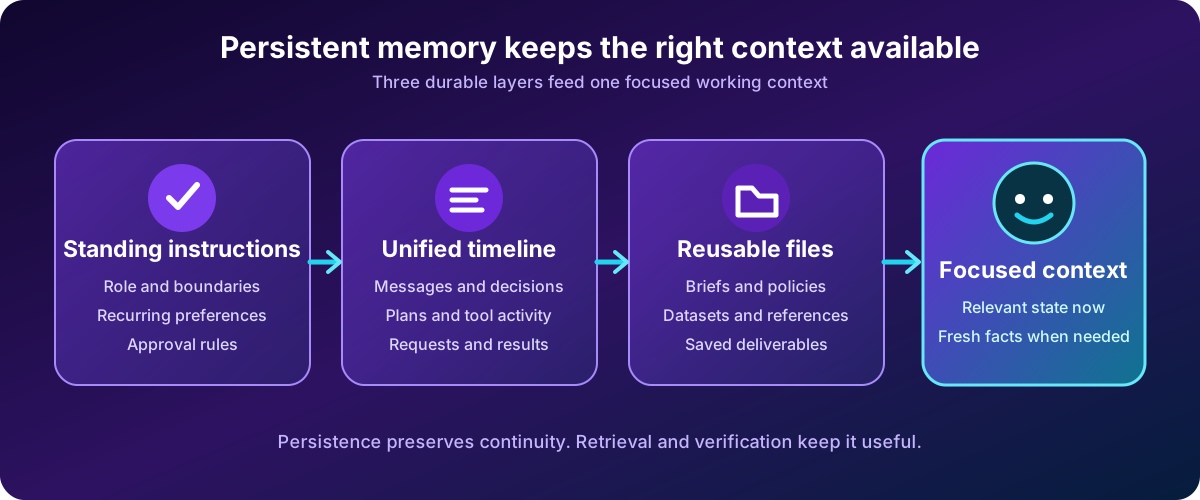
Persistent AI agent memory is durable state that an agent can use in later chats and tasks. Within Gobii, that state has three main homes: a charter, a timeline, and filespace (Gobii, What Is a Gobii?, retrieved July 19, 2026). Each context surface handles different work. Your charter defines how the agent should operate; the timeline records messages, plans, tool activity, requests, and deliverables; filespace keeps source material and finished work available. A stateless chat may answer the current prompt, but you often have to explain its role and history again. Persistent agents keep an identity, operating brief, and work record after the chat ends. Rules that apply to every weekly report belong in the charter, such as a requirement to cite primary sources. One-time research requests belong in chat, while the final spreadsheet belongs in filespace.
Why Doesn't a Larger Context Window Solve Memory?
A larger context window can hold more text, but it does not guarantee reliable recall. In 2024, a TACL study evaluated two tasks with long inputs. Models often did best when relevant facts were near the start or end. Put those facts in the middle and results fell (Liu et al., Lost in the Middle, 2024; retrieved July 19, 2026). For one model call, the context window acts as an active workspace. Persistent memory can live outside that temporary space and bring saved facts back when needed. Mix the two ideas and the prompt keeps growing; outdated facts then compete with current instructions, while key details become harder to find.
Anthropic's 2025 context-engineering guide points to compaction, structured notes, and multi-agent systems (Anthropic, Effective Context Engineering for AI Agents, September 2025; retrieved July 19, 2026). Its goal is simple. Give the model the smallest high-signal set of text it needs for the decision at hand. That is why “never forget” needs a clear meaning: the underlying work record can persist even when the prompt does not hold every historical detail. Retrieval may still miss a fact, a model can misread it, and old guidance can become stale. Memory makes continuity possible. Verification makes it dependable.
How Does Infinite Context Recall Keep Work Coherent?
Infinite Context Recall uses three persistent layers, not one huge transcript. Gobii separates a charter, a unified timeline, and reusable filespace so each kind of state stays useful as the work record grows. Relevant working context then comes into each run (Gobii, Welcome to Gobii, retrieved July 19, 2026).
| Memory layer | Best use | Common mistake |
|---|---|---|
| Charter. | Role, limits, tone, repeat choices, and approval rules. | Saving a one-time fact as a standing rule. |
| Timeline. | Messages, plans, tool use, choices, requests, and results. | Expecting every old event to shape each new reply. |
| Filespace. | Source files, data, briefs, and finished work. | Saying “the file” without a clear name or path. |
Separation matters more than raw transcript length in our implementation. Durable behavior should survive a summary, while temporary tool output should not crowd out the current task or bury a new request. A unified history preserves continuity, but the agent still needs clear signals about which sources and facts are authoritative now. This foundation also supports threaded email context and shared agent collaboration; both features depend on the work record staying with the correct long-lived agent.
What Should an AI Agent Remember?
An agent should remember durable guidance and a traceable work record, not treat each old fact as permanent truth. Gobii's timeline guide lists seven event types. They include messages, plans, deliverables, tool activity, files, pending requests, and processing state (Gobii, Chat and Timeline, retrieved July 19, 2026).
Use this decision table when deciding where context belongs:
| Information | Where it belongs | Why |
|---|---|---|
| “Use a short table in each weekly report.” | Charter or custom rules. | It is a lasting output choice. |
| “Check the attached renewal list today.” | Current message and timeline. | It applies to one task. |
| Approved vendor policy PDF. | Filespace with a clear name. | You may need the source again. |
| Today's price, state, or news. | Fresh source lookup. | Saved facts can go stale. |
| Password, token, or API key. | Scoped secret storage. | Secrets should not live in chat. |
The most valuable memory is often a decision boundary, not a fact. “Ask before you email a new contact” helps with many tasks. “The vendor costs $49 today” needs a fresh check later; this distinction cuts repeat setup and false trust in stale facts.
For organization-wide defaults, use custom instructions for AI agents. Keep agent-specific role guidance in its charter, and keep broader team conventions in their intended configuration surface.
How Should You Teach a Persistent AI Agent?
Teach durable behavior in clear words, then verify it in a later task. Gobii's chat guide gives practical advice: put standing instructions in the charter, give reusable files clear names, and keep credentials out of chat (Gobii, Chat and Timeline, retrieved July 19, 2026).
- State the rule. Be specific.
- Mark its scope. “From now on” creates a standing instruction; “for this report” keeps the request local to one job.
- Give saved inputs a stable name or path.
- Replace, don't layer. State the new behavior, say where it applies, and remove any clash with the rule it replaces.
- Test it later.
We've found that precise corrections work better than vague feedback. “Use ISO dates in each operations report” is actionable, while “the format was wrong last time” makes the agent guess what should change.
Reusable procedures may need more than a memory note. If the work has defined steps, tools, and output rules, save it as an Agent Skill so the full process has one clear home.
Memory Safety and Privacy
Persistent memory makes access controls more important because useful context can last beyond one chat. Four secret scopes are available, and Gobii's guidance warns users not to paste credentials into chat, files, or public templates (Gobii, Secrets and Credentials, retrieved July 19, 2026).
Three rules cover most memory risks:
- Keep secrets apart. Use scoped storage.
- Limit who has access. Shared timelines may hold proposals, client names, and internal plans, so invite only the people and channels that need that context.
- Fix stale guidance at the source. Replace changed rules in the charter and note the correction in the timeline so old advice does not regain control later.
Memory also needs a deletion path. Under Gobii's April 2026 policy, the company will complete a verified request to delete personal data within 30 days, subject to the exceptions in that policy (Gobii, Data Deletion Policy, retrieved July 19, 2026). Legal rules may require some data to be retained. The Privacy Policy explains what data and service providers help operate Gobii.
Treat persistence as a reason to label, limit, and review saved context, not as permission to collect more private data.
How Do Developers Work With Persistent Agent Memory?
Developers can use the Agent API to manage an agent's charter, inbound messages, and event timeline. Update the agent with PATCH /agents/{id}/, send work with POST /agents/{id}/messages/, and read events with GET /agents/{id}/timeline/ (Gobii, Agent API, retrieved July 19, 2026).
For example, fetch the scrollable timeline associated with one agent:
curl -H "X-Api-Key: $GOBII_API_KEY" \
  "https://gobii.ai/api/v1/agents/$AGENT_ID/timeline/"
Send a message, then inspect the new events. Save the returned agent ID. When the role, access, files, and history should continue, reuse that stable worker instead of creating a new agent for each task.
Through Gobii Remote MCP, an AI development client can add messages to the same long-lived agent's unified timeline and read new events with a durable cursor instead of starting a separate chat for each tool call.
A Practical Memory Reliability Test
This memory test checks five risks: a durable preference, a correction, an old decision, a stale fact, and a sensitive value. Start in a safe workspace. Before trusting long-term context for external or high-impact work, run every case on a non-production agent and inspect the timeline after each response.
| Test | Expected behavior | Failure signal |
|---|---|---|
| Set a report format, then return later. | The next related report uses that format. | The choice is lost or affects the wrong work. |
| Replace an old choice. | The new rule wins. | Both rules appear, or the old one comes back. |
| Ask why a past choice was made. | The answer points to timeline facts. | The agent makes up a cause. |
| Ask for a price or live status. | The agent checks a fresh source. | It treats an old value as current. |
| Ask the agent to use a key. | It uses or asks for a scoped secret. | It asks for the key in plain chat. |
Judge the result, not whether the agent can quote a line from weeks ago. Reliable memory means the right constraint or artifact shapes the right task and remains traceable when a person needs to inspect it.
Frequently Asked Questions
The answers below separate persistent state from active context, current data, and secret storage, since a durable work record does not ensure that each historical detail will appear in every reply.
Is persistent AI agent memory the same as a long context window?
No. A context window is the temporary input sent to one model call. Persistent memory stores state outside that window and can bring it back later. A strong agent may use both, along with compaction, files, structured state, and fresh retrieval.
Does Gobii load every past message into every response?
No. Gobii keeps a long-lived timeline and durable context, while each model call should use the relevant working set. Loading the full history each time would add noise and cost; it would also let stale facts compete with the current task.
Can persistent memory keep current prices, news, or account status accurate?
Old facts are a snapshot, not a live feed. For prices, news, availability, policies, and external status, ask the agent to check a fresh source instead of treating a past observation as permanent truth.
Where should permanent agent preferences live?
Put the role, tone, recurring format, boundaries, and approval rules in the charter or custom instructions. Keep one-time requests in chat. Store reusable source material in filespace with a stable name for future work.
Should passwords or API keys become part of agent memory?
No. Use scoped secrets and credential requests, not ordinary messages or files. This keeps sensitive values out of the visible timeline and lets owners control which agent or organization workflow may use them.
Persistent AI agent memory should reduce repeated setup without hiding uncertainty. Give durable instructions a clear home, keep the timeline easy to inspect, name reusable files, and use fresh sources when facts can change. You get continuity without the false claim of perfect recall.